SEO matters for personal injury lawyers because it decides whether your firm exists at the one moment that actually determines most cases: the minutes right after someone is hurt, when they reach for their phone and search for a lawyer before they’ve called anyone else including, often, before they’ve called an insurance adjuster back. Rank on page one and you’re in that conversation. Rank on page two, or nowhere, and a competitor gets the call, the case, and the fee.
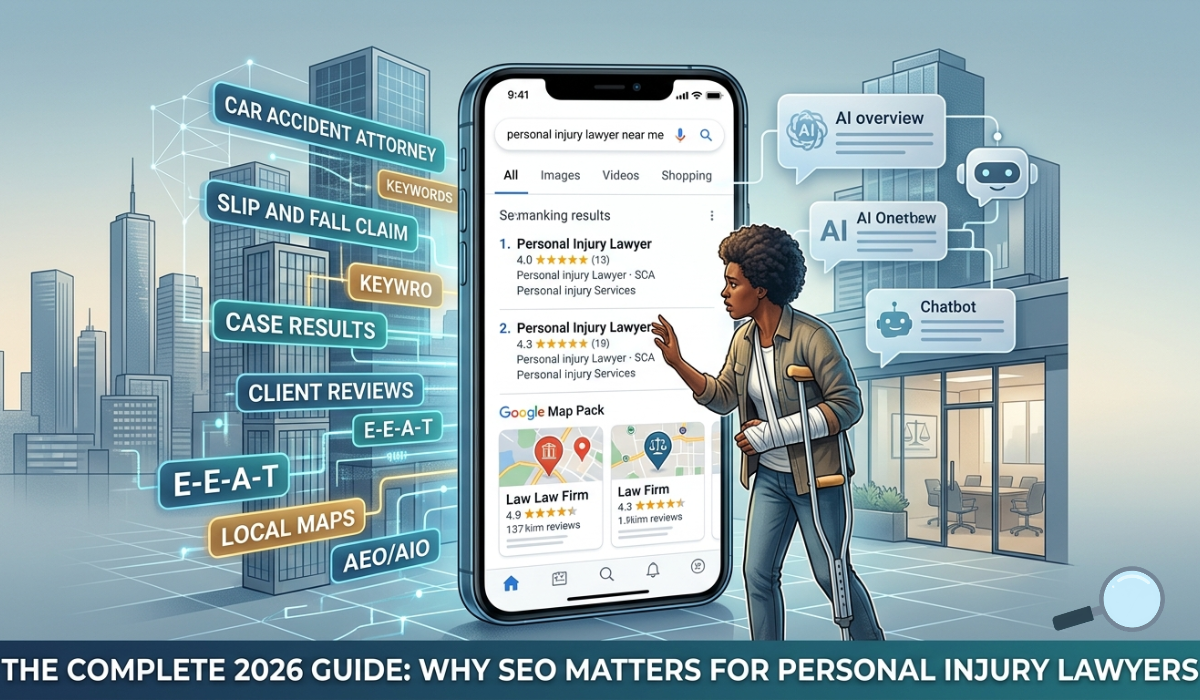
That fact has gotten sharper in 2026, not softer. Injured people aren’t only Googling anymore. A growing share are also asking ChatGPT or Google’s AI Overviews which lawyer to call and as you’ll see below, the data shows those AI answers overwhelmingly favor firms that already rank well organically. SEO isn’t competing with AI search for your marketing budget. It’s the raw material AI search runs on.
Here’s the full picture: why SEO matters specifically for personal injury firms, what Google’s July 2026 updates actually changed, how E-E-A-T really works (not the watered-down version), and how to show up across AEO, GEO, and AIO the systems increasingly deciding who gets found first, before a searcher ever sees a “traditional” result.
Key takeaways
- Personal injury is one of the most searched, most competitive, and most expensive legal niches online which makes SEO’s ROI advantage over PPC larger here than almost anywhere else in law.
- Google shipped no new core update in July 2026, but it quietly reshaped how AI Overviews cite sources and rolled out Search Profiles, a new author-identity feature that raises the bar on E-E-A-T for legal content.
- E-E-A-T isn’t a ranking factor you can “add” to a page, it’s the framework Google’s human raters use to judge whether YMYL content like legal advice deserves to rank, and personal injury sits squarely in YMYL territory.
- AEO, GEO, and AIO are related but distinct: AEO wins the answer box, GEO wins the AI citation, AIO builds the cross-platform trust that makes both possible and all three sit on top of standard SEO, not instead of it.
- Firms publishing generic, AI-paraphrased content are already losing visibility; firms publishing original data, named-author expertise, and structured answers are gaining it.
Why Does SEO for Personal Injury Lawyers Matter? 5 Core Reasons
1. It captures clients at the only moment that matters
Nobody comparison-shops for a personal injury lawyer the way they shop for a mattress. There’s no browsing phase. Someone gets hurt, the pain and the paperwork start immediately, and within hours sometimes minutes they are searching “car accident lawyer near me” or “do I have a case after a slip and fall.” According to Clio’s Legal Trends Report, 96% of legal consumers begin their search online, and 74% check out a firm’s website before ever making contact. If you’re not visible in that narrow, high-adrenaline window, you don’t lose a click you lose the case.
2. It wins (or loses) the Google Map Pack
Personal injury is inherently local. Clients want a lawyer who knows their state’s statute of limitations, their local courts, and their local insurance adjusters. The 3-listing “Map Pack” that appears above organic results captures a disproportionate share of clicks for these “near me” searches, and it’s driven by a different set of signals than organic SEO: Google Business Profile completeness, NAP (name, address, phone) consistency, and review volume and recency. Firms that ignore local SEO are invisible in exactly the search results injured people trust most.
3. It builds the trust a stranger needs before they’ll call you
Hiring a personal injury lawyer means trusting a stranger with your health, your finances, and possibly your future. Ranking well is itself a trust signal people subconsciously read “appears on page one” as “must be reputable.” But it only works if the content backing that ranking actually earns the trust once someone clicks through, which is where E-E-A-T (covered in detail below) comes in.
4. It compounds PPC stops the second you stop paying
Personal injury is one of the most expensive practice areas to bid on in Google Ads; a single click on a competitive “car accident lawyer” term can run well into double digits. SEO has a real cost too but a ranking you’ve earned keeps generating calls for months or years after the work is done, instead of evaporating the day you pause a campaign. One widely cited industry analysis from FirstPageSage put the average 3-year ROI of law firm SEO at over 500%, precisely because of that compounding effect.
5. It’s now the raw input AI search runs on
This is the part most “why SEO matters” articles from 2025 miss entirely. A 2026 consumer survey by iLawyerMarketing found that 60% of consumers say they’d use AI to help research which law firm to hire and among the 45–60 age group, which overlaps heavily with prime personal injury and family law clients, that number climbs past 75%. Critically, the same research found that the firms AI tools recommend are disproportionately the firms that already rank well on Google. AI search isn’t replacing SEO. It’s reading your SEO and repeating it back to the searcher.
The Numbers Behind the Case for SEO
If you need to justify an SEO investment internally, here’s the 2026 data:
- 135,000+ personal injury lawyers are practicing in the U.S. roughly 1 in 10 of all 1.3 million licensed attorneys competing inside a $61.7 billion market that’s still growing.
- ~400,000 personal injury claims are filed in the U.S. every year, per U.S. Department of Justice data cited by Clio and personal injury consistently ranks among the top three legal needs consumers report.
- 96% of legal consumers start their search online; 74% vet a firm’s website before contacting it (Clio Legal Trends Report).
- 60% of consumers say they’d use AI to help choose a lawyer rising to 75%+ among 45–60-year-olds (iLawyerMarketing, 2026).
- 34% of U.S. adults have used ChatGPT as of mid-2025, per Pew Research Center, a number that has only grown since.
Put together, this is a large, growing, high-intent market searching primarily online and increasingly through AI intermediaries that lean on organic rankings to decide who to recommend. That’s the actual, numbers-backed answer to “why does SEO matter for personal injury lawyers.”
What Google’s July 2026 Updates Changed And What It Means for Your Firm
Most “SEO for personal injury lawyers” articles you’ll find were written months ago and never touch this. Here’s what’s actually current as of this writing:
No new core update landed in July. Google’s most recent broad core update rolled out in May 2026 described by Google as a routine recalibration to surface more relevant, satisfying content across all site types and had fully settled by early June. July was a quieter month for ranking systems, but not for the search results page itself.
The June 24, 2026 spam update rolled out in roughly two days and specifically targeted Google’s spam-fighting systems (like SpamBrain) rather than broad content-quality ranking. It hit thin doorway pages, scaled AI-generated junk, and templated content harder than genuinely useful pages a pattern worth noting if you’ve seen unexplained ranking swings since late June.
AI Overviews got more prominent, not less. Industry trackers reported that Google added a live news carousel, AI-generated imagery, and most relevant here new citation displays inside AI Overviews, making it more visible which sources an AI-generated answer is actually pulling from. Search Console also picked up new tools for site owners to see how their content is being used inside AI features. For a firm doing genuine, well-structured content, that’s an opportunity: better citation visibility means better odds of the click actually landing on your site instead of disappearing into a summary.
Google Search Profiles (Publisher Profile Pages) went live. This is the one worth paying attention to. It’s a new author-identity feature and it plugs directly into E-E-A-T, since it gives named authors and experts a persistent, verifiable identity Google can attach to their content across the web. For a YMYL niche like personal injury law, having your named attorneys and content strategists set these up is quickly becoming table stakes rather than a nice-to-have.
The next core update is expected in Q3 2026 (most likely August or September), based on Google’s typical three-to-four-month cadence rather than any official confirmation. That gives firms a real window right now to tighten up content quality and author signals before the next recalibration.
How E-E-A-T Actually Works (Not the Oversimplified Version)
Almost every competing article name-drops E-E-A-T. Very few explain it correctly, so here’s the accurate version.
E-E-A-T is not a ranking factor Google plugs into an algorithm. It’s the framework laid out in Google’s Search Quality Rater Guidelines a 176-page document given to the thousands of human quality raters who manually review search results. Those raters don’t change your rankings directly. Their assessments train and calibrate Google’s actual ranking systems over time, so that pages behaving like the low-E-E-A-T examples raters keep flagging gradually lose ground, and pages behaving like the high-E-E-A-T examples gradually gain it.
This matters enormously for personal injury content specifically, because legal advice is a textbook example of YMYL Your Money or Your Life. Bad information here can cost someone their settlement, their health, or their legal rights, so Google’s raters are instructed to hold YMYL content to a materially higher standard than, say, a recipe blog.
Breaking down the four letters as they apply to a personal injury site:
- Experience Has the person behind the content actually handled cases like this? Real, specific outcomes beat generic “we fight for you” copy every time.
- Expertise Bar admission, years of practice, specific case-type knowledge, visible credentials on attorney and author bios.
- Authoritativeness What the rest of the internet says about you: legal directory listings, local news mentions, bar association features, backlinks from sites Google already trusts. This overlaps heavily with GEO, below.
- Trustworthiness The load-bearing pillar. Google has stated content cannot score well on E-E-A-T without it. Accurate information, transparent attorney identities, required attorney-advertising disclaimers, genuine reviews, a secure and accurate site.
The stakes of getting this wrong are no longer theoretical. Data from SE Ranking following the March 2026 core update found that sites publishing original, first-hand data gained roughly 22% more visibility, while sites running AI-paraphrased, generic content lost as much as 71% of their traffic. Generic content isn’t just uninspiring anymore it’s a measurable ranking liability.
A practical E-E-A-T checklist for a personal injury blog:
- Named author with real credentials (headshot, bar number, years practicing) on every substantive legal page
- Genuine case results, published within your state bar’s advertising rules check your specific jurisdiction before publishing outcomes or testimonials, since rules vary by state
- Real, recent client reviews that your firm actively responds to
- Clear “Attorney Advertising” disclaimers where your state requires them
- Cited sources for every statistic never invented numbers
Beyond Google: How to Rank in AEO, GEO, and AIO
These four terms get thrown around almost interchangeably in 2026 marketing content, and honestly, the industry itself hasn’t fully settled the boundaries. But the distinctions are useful once you understand them:
| Term | What it optimizes for | What it depends on most |
| SEO | Ranking position in traditional search results | Technical health, on-page content, backlinks |
| AEO (Answer Engine Optimization) | Winning the direct-answer slot featured snippets, People Also Ask, AI Overviews | Content structured as clear question + direct answer, with the answer in the first sentences |
| GEO (Generative Engine Optimization) | Being cited or recommended by name inside AI chat answers (ChatGPT, Perplexity, Gemini, Claude) | Your reputation across the whole web directories, reviews, local press, consistent NAP more than your own page |
| AIO (AI Optimization) | The broader trust layer AI systems use to decide whether to reference you at all | Cross-platform consistency, structured data, overall digital footprint |
A few things worth knowing before you spend a budget on any of this:
Google AI Overviews still pull mostly from your top-10 organic results meaning AEO and SEO don’t replace SEO, they’re built on top of it. A page that can’t rank traditionally has very little chance of getting cited in an AI answer either.
Independent research from Princeton on generative engine optimization found that adding expert quotes, statistics, and citations to a page meaningfully increased how often it got cited in AI-generated answers, a strong argument for exactly the kind of data-backed, sourced content this article is modeling.
And one honest caveat: Google has been explicit that no special llms.txt file, secret schema markup, or paid “AI visibility” tool guarantees placement in an AI answer. Anyone promising guaranteed AI placement isn’t being straight with you. What actually works is unglamorous: standard technical SEO, genuinely original content, and real reputation signals built consistently over time.
Practical tactics that help all four layers at once:
- Structure content as direct question + immediate answer, then elaborate (exactly the format this article uses)
- Add FAQ sections marked up with FAQPage schema
- Keep your firm’s name, address, and phone number identical across every directory, citation, and page footer
- Get listed and cited consistently on legal directories (Avvo, Justia, FindLaw), bar associations, and local press
- Publish original case data and firsthand insight instead of rewriting what competitors already said
- Implement Attorney, LocalBusiness, and Article schema so both search engines and AI crawlers can parse who you are
SEO Strategies That Actually Move the Needle for Personal Injury Firms
- Go granular with keywords. “Personal injury lawyer [city]” is table stakes. The real opportunity is injury-type-plus-location-plus-moment content: “what to do after a T-bone collision in [city],” “slip and fall claim deadline in [state],” “should I accept the insurance company’s first offer.”
- Win the Map Pack deliberately. Complete every field in Google Business Profile, use accurate categories like “Personal Injury Attorney,” and build a steady (not one-time) flow of recent reviews.
- Build E-E-A-T into the content itself, not as an afterthought named authorship, real outcomes, cited data, clear disclaimers.
- Earn backlinks, don’t buy them. Legal directories, local news coverage of case outcomes or community involvement, and bar association features carry far more weight than a purchased link ever will.
- Fix the technical layer first. None of the content work matters if your Core Web Vitals are poor or the site isn’t genuinely mobile-first and most injury searches happen on a phone, often one-handed, often stressed.
- Track signed cases, not just traffic. Connect analytics to intake so you know cost-per-signed-case from organic search, not just cost-per-click. Traffic is a vanity metric until it’s tied to revenue.
Mistakes That Quietly Kill Personal Injury Rankings in 2026
- Publishing unedited, AI-generated content. It reads as generic to human visitors and, per the SE Ranking data above, is now measurably losing rankings too.
- Anonymous “blog team” bylines on legal advice. On a YMYL topic, an unnamed author is a trust gap Google’s raters are specifically trained to notice.
- Treating AEO and GEO as optional. If AI answer engines are already influencing 60%+ of prospective clients, ignoring how your content performs there is ignoring where a majority of research now happens.
- Inconsistent NAP across directories. A different suite number on Yelp than on your own footer reads as two different businesses to Google.
- Going all-in on PPC with no organic investment. It buys visibility for exactly as long as the budget lasts, and nothing after.
Frequently Asked Questions
Why does SEO matter more for personal injury lawyers than for other legal niches?
Personal injury combines high search volume, high-value cases, extreme local competition, and a genuinely urgent moment of intent a combination few other practice areas share to the same degree, which is what makes ranking here both harder and more valuable.
How long does personal injury SEO take to show results?
Most firms see initial ranking movement in 3 to 6 months, with meaningful, compounding lead growth in the 6 to 12 month range. SEO is a channel that builds rather than switches on overnight.
Does AI search replace the need for traditional SEO?
No. AI Overviews and chatbot recommendations are drawn substantially from the same organic rankings SEO produces; the 2026 data above shows AI tools disproportionately recommend firms that already rank well, so strong SEO is now feeding two channels instead of one.
What’s the difference between SEO and PPC for a personal injury firm?
PPC buys immediate visibility for as long as you keep paying for it. SEO takes longer to build but keeps generating calls without an ongoing per-click cost, which is why the two usually work best as complements rather than substitutes.
What is E-E-A-T, and why does it matter more here than in other niches?
E-E-A-T (Experience, Expertise, Authoritativeness, Trustworthiness) is the framework Google’s human quality raters use to judge content credibility. Personal injury is a YMYL topic. Bad advice can cost someone real money or their legal rights so Google holds it to a materially higher trust bar than most other content categories.
How Web SEO for Lawyers Helps
This is exactly the kind of work we specialize in: personal injury firms are the single most competitive vertical in legal SEO, and generic marketing playbooks don’t survive contact with it. Our approach is built around the same principles covered above: strict E-E-A-T compliance and attorney-advertising awareness, content and schema engineered for AEO and GEO visibility (not just traditional rankings), and Google Map Pack strategy built for how injured clients actually search.
If you want a clear picture of where your firm currently stands, start with a free audit, or see the full breakdown of our personal injury law firm SEO services.