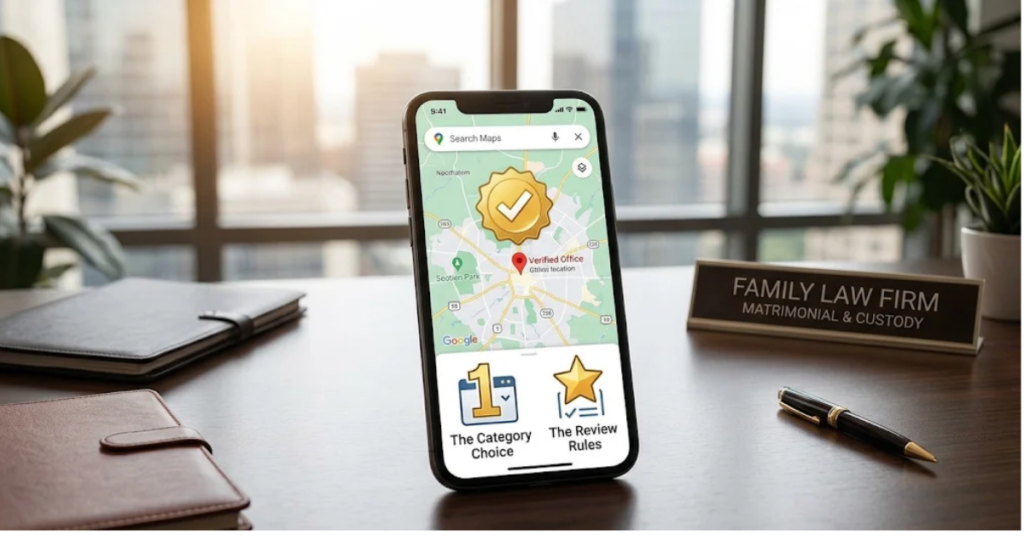
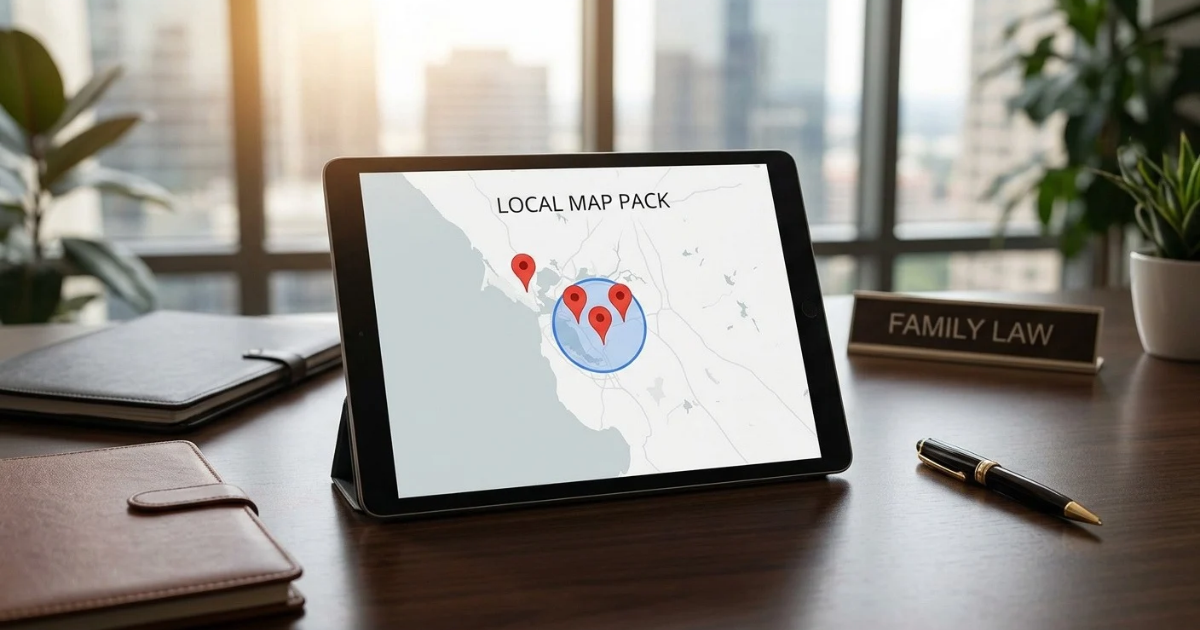
You can win the Map Pack in the county where your office sits and in the stretch of the next county your office is close to. You can’t win it in a county where you only file cases. Local SEO for family law firms is the work of earning a place in Google’s local three-pack for searches made near your verified office, and a county line doesn’t change who counts as near.
Family law has a quirk most practice areas don’t. The court’s geography and the searcher’s geography come apart. What follows shows where, and gives you a way to sort every county you care about into winnable and not.
How does Google decide who appears in the Map Pack?
Google says local results rest mainly on relevance, distance and popularity. Distance runs from the searcher, or from the place named in the query, to your pin. Moving it means moving your verified office. Relevance and popularity are yours to work on: profile completeness, categories, reviews, links and mentions.
Google’s help page on local ranking names those three factors, attaches no weights to them, and says you can’t pay for a better local rank. I checked it on October 4, 2026. Any article that credits Google with a percentage for profile completeness is quoting something that page doesn’t contain.
The best ranking data outside Google is Whitespark’s 2026 Local Search Ranking Factors, a survey that asks 47 local SEO specialists to score factors. These are expert opinions. Whitespark is clear that none of them can see Google’s code. Their top five for the local pack:
| Rank | Factor | Can you change it this quarter? |
| 1 | Primary Google Business Profile category | Yes |
| 2 | Proximity of your address to the search point | No, not without moving |
| 3 | Keywords in the business name | Technically. See below. |
| 4 | Physical address in the city searched | No |
| 5 | Business open at the time of search | Within limits |
Two of the five are fixed by where your door is. No agency can change that for you.
Agency pages also attach percentages to groups of factors. Those numbers disagree from page to page, so I’ve left them out.
Why can’t local SEO for family law firms cover a whole county?
Google measures distance from the searcher, or the place named in the query, to your pin. A county is a legal boundary that decides where a case is filed. A Dallas firm can have a client who must file in Collin County and still sit a county away from her search.
I read five pages in full on October 4, 2026, all ranking for this keyword or its close variants. Two say the Map Pack works at the city and county level. None of the five mention the review rule Google added in April 2026, which matters later in this piece. Google’s documentation says distance. Counties are legal units. Distance is geometry.
Family law makes the gap expensive. In Texas, as of October 2026, a divorce can’t be maintained unless one spouse has been a state domiciliary for six months and a resident of the filing county for 90 days (Tex. Fam. Code § 6.301). Venue follows where the spouses live. Your office has nothing to do with it.
Other states set their own residency periods and venue rules, so the Texas numbers are an example of the mechanism, not a template.
Picture a three-attorney firm with one office in Dallas County. A prospective client has lived in Plano for years, so her case is most likely filed in Collin County, and the courthouse is in McKinney. She searches from her kitchen table. The firms Google treats as close to her are the ones near Plano. If she types a county name instead, distance is measured from that county, and a Dallas pin is still a county away. No amount of “Collin County” copy on your website moves the pin.
[AUTHOR: replace this hypothetical with a real, anonymized grid scan from a client if you have one.]
The organic half of the problem, the practice-area pages and the content behind them, belongs to the wider work of SEO for family lawyers. This piece stays on the pack.
The County Triage: 4 territories, 4 questions
The County Triage sorts each county you want into one of four territories. It’s a framework I built for this article, not measured data. Ask these in order, for one county at a time:
- Is your verified office inside the county?
- If not, does a grid scan centered on the county’s main population center show your pin ranking in part of it?
- Do clients there have to file there, and are you admitted in that state?
- Anything else is closed to you.
| Territory | Test | Map Pack realistic? | What to do instead |
| Home pin | Verified office inside the county | Yes | Full profile work, reviews, local links |
| Edge | No office, but your pin ranks in part of the county | Partly, near the border | Organic pages, paid search for the rest |
| Venue-only | Clients file there, your pin doesn’t rank | No | Real county pages, paid search, referrals |
| Closed | Not admitted, or not served | No | Nothing |
Run the scan with a grid tool such as Local Falcon, centered on the population center, with the keyword a client would use.
Back to the Dallas firm. Its six neighbors are Collin, Denton, Tarrant, Ellis, Kaufman and Rockwall. My expectation is that the counties whose people live nearest the office come out Edge and the farthest come out Venue-only. That’s a hypothesis to test, not a result. If it turns out wrong, the grid is right and my guess isn’t.
Grid results shift with the scan point and the time of day, so compare a scan against your own earlier one, run the same way, and not against a screenshot made with somebody else’s settings.
Here’s a position some agencies won’t like. A solo lawyer or a two-lawyer firm with one office should pick the Home pin county and at most one Edge county, then ignore the rest of the map. Spreading effort across six counties gets you six thin pages and six half-built reputations. A firm with several attorneys and a real intake team can afford to work the Edge. A small one is better off owning its home turf first.
A second office gives you a second Home pin. It also gives you a lease, a staffing bill and a second set of reviews to earn from zero. For most firms under ten lawyers I’d run the triage first and sign the lease later, if ever.
What can a family law firm change on its Google Business Profile?
Three things move the profile most: the primary category, the business name and the hours. Only the category is a clean win. Keywords in the name collide with Google’s name guideline and Rule 7.1, and extended hours only help if you actually keep them.
Start with the primary category. Whitespark’s experts put it first. Pick the one that matches the work you want most, not the one that describes everything you do. Secondary categories are for work you actually take.
Local SEO for family law attorneys: the name and hours tradeoffs
The experts rank keywords in the business name third. For lawyers I’d skip that lever, and here’s the argument.
Google’s guideline says the name should match the real-world name your business uses on its signage, website and stationery. ABA Model Rule 7.1, comment [5], treats firm names as communications about a lawyer’s services that can’t be false or misleading. States vary; California, for one, keeps a separate Rule 7.5 on firm names. A profile called “Dallas Family Lawyers” for a firm whose door says something else is a name you can’t defend to Google or to bar counsel. The ranking lift isn’t worth being the lawyer who has to explain it.
If your registered name already carries a practice term, it’s yours to use. That decision was made years ago.
Hours are the other tradeoff. Whitespark’s fifth factor is being open when someone searches. Searches don’t stop at five. A staffed answering service during listed hours makes the hours true. Stretching the hours you list doesn’t. A prospect who calls at 9 p.m. and reaches voicemail has been misled by your listing, and no ranking gain covers that.
How should a family law firm ask for Google reviews now?
Send the review link after the matter closes, away from your office, with no quota and no script naming staff. Google added language in April 2026 against pressuring people to leave reviews while on the premises, and against asking staff to collect a set number of reviews or reviews that name a staff member.
That’s the current text of Google’s contributed content policy. Read it yourself rather than trusting my paraphrase.
The old habit was a card or QR code handed over at the final signing. It now sits close to the line. Moving the ask to an email a week after the order issues costs you some volume and buys you a clean process.
Volume is a separate problem. Family law clients often don’t want their divorce attached to a public profile. Expect a low response rate, and don’t read it as a service failure.
Replies carry their own risk. Model Rule 1.6 bars disclosing client information, and a reply that confirms the reviewer was a client has disclosed something. Answer in general terms: you can’t discuss any client’s matter, and here’s the office number.
Should a family law firm build a page for every county?
Only where you can fill the page with court-specific content you can verify. Google’s Search Status Dashboard lists a spam update that began rolling out on September 24, and coverage of it points to enforcement against scaled content, including templated city pages. If swapping the county name is the only difference between two pages, don’t publish them.
Family law local SEO in practice: the swap test
Take any county page you’re planning and replace its county name with the neighboring county’s. If the page still reads as true, delete it.
A page that passes carries things only that county has: the courthouse address, the clerk’s filing process, a link to that county’s local rules, how its family court handles the matters you take. Verify each against the county’s own site and link to it.
Build these for Edge and Venue-only counties. Your Home pin county gets the office page. Closed counties get nothing.
How long does it take to rank in the Map Pack?
Nobody can give you a reliable number. Google publishes no timeline, and the ranges on agency pages, from three months to ten, cite no data. Run a grid scan before you start, rerun it monthly, and judge progress by cells turning around your office, not by a promise.
Frequently Asked Question:
Can a family law firm rank in the Map Pack for a county where it has no office?
Sometimes, near the border. Distance runs from the searcher or the place named in the query to your pin, so deep inside a county with no pin it’s rare. A grid scan shows where it holds.
Does the Map Pack work at the county level?
Google’s documented factors are relevance, distance and popularity. County boundaries aren’t among them. A county name in a query sets a location to measure from, which is different from a boundary you can rank inside.
Should a family law firm add keywords to its Google Business Profile name?
Not unless the keyword is part of the name on your door. Google’s guideline asks for your real-world name, and ABA Model Rule 7.1, comment [5], bars false or misleading firm names. Check your state’s rule before deciding.
Can we ask clients for Google reviews at the end of a meeting in our office?
I wouldn’t. Google’s April 2026 policy language targets pressure to review on the premises and staff quotas. Send the link afterward, by email, without a quota.
How do I see which counties my firm shows up in?
Run a grid scan with a tool such as Local Falcon, centered on each county’s main population center. Repeat monthly.
Is a location page for every county worth building?
Only for Edge and Venue-only counties, and only with facts specific to that county’s court. Pages that differ by the county name alone are the kind of scaled content Google’s September 2026 spam update is described as targeting.
How long does it take to rank in the Map Pack?
No one can promise a timeline. Measure your own movement with a monthly grid scan.